Swimming Holes at a Glance
The Cairns region has natural swimming holes in national parks and rainforest creeks. Conditions change quickly after rain, so check current park alerts and signs before you swim. This guide lists the swimming holes and what to know about each.
“There is a particular kind of quiet at a rainforest swimming hole — cool water, green light, and birdsong where you expected silence.”
Natural Swimming Holes in the Cairns Region
The swimming holes of North Queensland are one of the region’s greatest gifts. Tucked within national parks, accessible from the highway, or reached by a rainforest walk that earns every stroke of the swim at the end — these natural pools, fed by creeks and waterfalls from the mountain ranges, are part of the deep pleasure of visiting this part of Australia.
The Atherton Tablelands is the swimming hole heartland. Millaa Millaa Falls, with its wide, clear pool beneath a full curtain of falling water, is perhaps the most celebrated. Nandroya Falls requires a longer walk but rewards it with two extraordinary cascades and a deep, still pool that feels genuinely remote and all your own. Malanda Falls, in the centre of town, is welcoming, safe, and perfect for families. Ellinjaa Falls and Lake Eacham’s swimming area round out a region that could keep a dedicated swimmer occupied for days.
Closer to Cairns, Crystal Cascades in the ranges above Redlynch is a series of pools and small waterfalls that has been a local favourite for generations — cool, clear, and surrounded by thick rainforest that filters the light into something magical. Josephine Falls, at the base of Mount Bartle Frere in Wooroonooran National Park, is described by Tourism Tropical North Queensland as a tiered cascade with its own natural water slide. It is also a site where conditions change quickly, so the signage on the day is what matters.
All swimming holes require awareness of conditions, particularly during and after heavy rain, when water levels can rise rapidly and currents develop in normally calm areas.


Swimming Holes Around Cairns


Cardwell Spa Pools
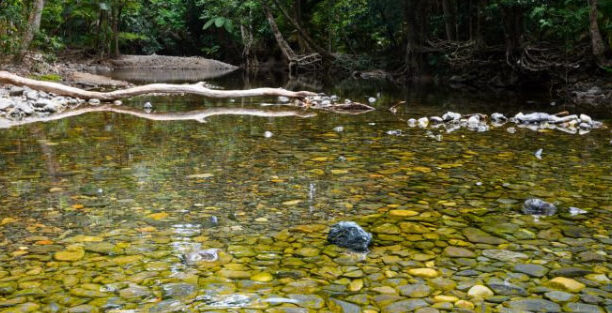
Natural rock pools near Cardwell — check current conditions on the page before you go.




Reef Tours from Cairns
Reef Experience
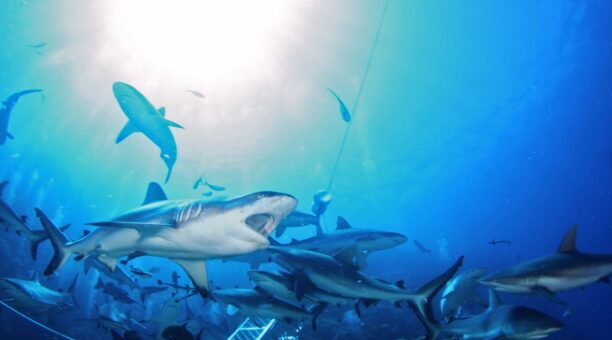
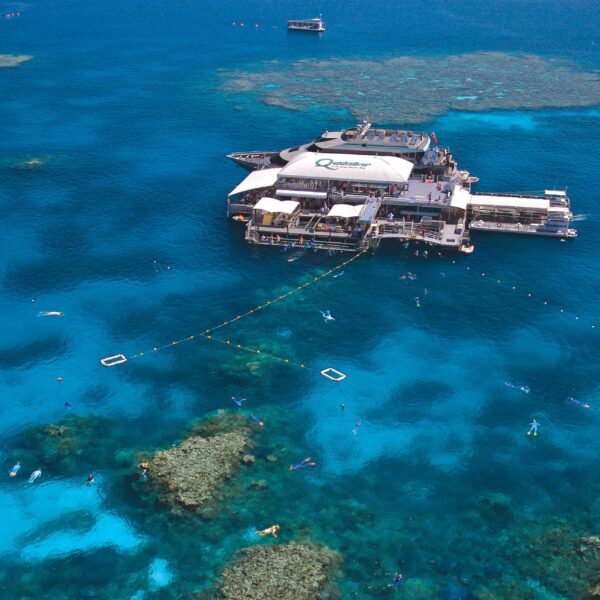
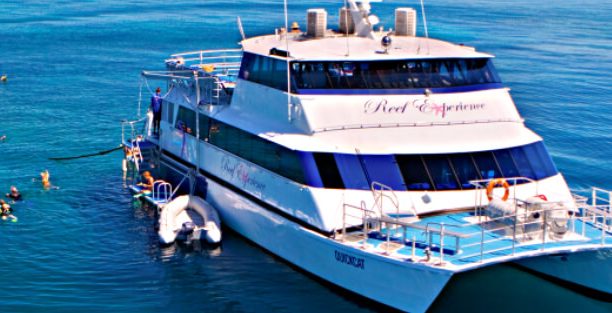
A day trip from Cairns to the Great Barrier Reef, with time in the water among the marine life.

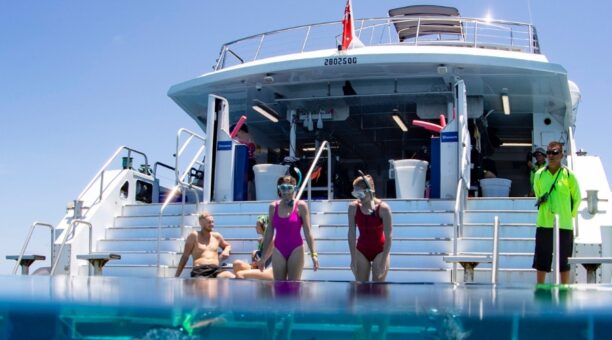


All Cairns Reef Tours
Compare snorkelling, diving and reef cruises from Cairns and find the right trip for you.
A Hot Getaways destination. Where Care is Our Compass.
Travel Kindly
At Hot Getaways, care is our compass — and a little kindness makes every journey better. When you visit Cairns, we gently ask you to:
- Protect the reef — wear reef-safe sunscreen and never touch or stand on the coral.
- Respect the wildlife — admire the birds, turtles and rainforest creatures from a distance, and take your rubbish home with you.
- Support local — choosing local operators, cafés and guides helps this beautiful place thrive.
- Honour Country — we travel on the traditional lands and sea Country of Australia’s First Peoples, with gratitude and respect to the Traditional Custodians past and present.
- Be kind to each other — a smile, a little patience and a helping hand make the day lovelier for everyone.
Small acts of care add up to something wonderful. Thank you for travelling kindly.
Honest Suitability: Is Swimming Holes Near Cairns Right For You?
We would rather help you choose well than persuade you to go. Here is our honest assessment.
| Visitor | Our honest view | Why |
|---|---|---|
| Confident swimmers | Yes | Most of these are unpatrolled natural pools with uneven bottoms, submerged rock and variable depth. Comfort in open water matters more than fitness. |
| Families with children | Yes at the easier sites, with constant supervision | None of these places has a lifeguard. Crystal Cascades and Babinda Boulders have Council-provided facilities and formed paths; the remote creek sites do not. |
| Non-swimmers and nervous swimmers | Choose a lookout instead | Several of these sites reward you just as much from the bank. There is no shame in a picnic and a paddle. |
| Visitors with limited mobility | Varies, and we name the source each time | Access to natural swimming holes is rarely described officially, but not never. Cairns Regional Council lists Crystal Cascades Park as wheelchair accessible; Queensland Parks and Wildlife Service states that the toilets at Alligators Nest and at the Lower Davies Creek camping area are wheelchair accessible, and that at Mossman Gorge the Grade 1 Baral Marrjanga track is suitable for wheelchairs, strollers and the vision-impaired. For most other holes nothing is published, and we say so rather than guess. Checked 3 August 2026. |
| Visitors during or just after heavy rain | Postpone | Water levels rise quickly and currents appear in places that are normally calm. This is the single most important sentence on this page. |
| Visitors wanting somewhere quiet | Yes, if you go early | The difference between eight in the morning and eleven in the morning at these sites is dramatic. |
Time-Aware and Season-Aware Planning
- An hour or two: Crystal Cascades is the closest option to Cairns and is managed by Cairns Regional Council, with barbecues, drinking water, a picnic shelter and a walking track.
- Half a day: Babinda Boulders, south of Cairns, is about six kilometres from Babinda township on Boulders Road and has toilets, barbecues, picnic tables, viewing platforms and a play area.
- A full day: the Tablelands sites, or the Josephine Falls and Behana Gorge side of the region. Add the walk-in time as well as the drive.
- Season: Rainfall here is strongly seasonal. Bureau of Meteorology long-term averages for Cairns Aero (station 031011, 83 years of record) are 404.8 mm in January, 437.5 mm in February and 422.1 mm in March, against just 26.5 mm in August, with an annual average of 2,025.5 mm. Source: Bureau of Meteorology climate statistics, Cairns Aero. The dry season gives you clearer, calmer water; the wet gives you volume and a much higher chance of closures.
- The common mistake is arriving at noon in the middle of the day with no towel and no shade. Early morning, a towel, and drinking water turn all of these places into better experiences.
Verified Safety Information
Safety comes before everything else on this page. Every point below is drawn from an official source, and we link to those sources so you can check the current position yourself.
- Queensland Parks and Wildlife Service, which manages these sites, states the position plainly: rivers, creeks and lakes in Queensland’s parks and forests may contain hidden dangers, are not patrolled by lifesavers, and are not the same as a swimming pool — you enter the water at your own risk. Read and follow the on-site signs, never dive or jump into any waterway because the water may be shallow or hold submerged objects, and stay out of the water during and after heavy rain, when creeks can rise quickly and run with strong currents. Source: Water safety, Queensland Parks and Wildlife Service.
- Never dive or jump into a natural pool. Depth changes with every flood and submerged rock moves.
- Queensland Government advice is unambiguous: within the natural range of the estuarine crocodile, which runs from around Gladstone north to the Torres Strait, no waterway can be considered crocodile free. Being Crocwise starts with three steps — keep out of the water, stay more than five metres back from the water’s edge, and keep a sturdy object between yourself and the water. Source: Be Crocwise top tips, Queensland Government.
- Crocodiles are highly mobile, particularly after heavy rain and flooding, and can travel hundreds of kilometres. Queensland Government also states that crocodile interactions can occur at any time of the year, so seasonal reasoning is not a substitute for reading the signage in front of you.
- This is cassowary country. Queensland Government advice is to never approach an adult cassowary, never approach a chick or get between a chick and its father, and never feed a cassowary — feeding is illegal, dangerous, and has resulted in cassowary deaths. Give them space and observe from a distance. Source: Southern cassowary, Queensland Government.
- Check Queensland park alerts and warnings for the Tropical North Queensland region before you leave home, together with current weather and road conditions.
- Cairns Regional Council provides and maintains the facilities at Babinda Boulders and Crystal Cascades. Council does not lifeguard them, and neither does anybody else.
Queensland Parks and Wildlife Service puts it plainly: parks and forests are wild places with hidden dangers for the unwary visitor. Before you leave home, check Queensland park alerts and warnings for the Tropical North Queensland region, along with current weather and road conditions, and pay close attention to warning signs when you arrive.
Every source above was checked and found current on 3 August 2026. Conditions, track access and closures change constantly. Queensland Parks alerts are the current source, and ranger signage on site overrides everything, including this page.
Local Knowledge
The points below are local knowledge and editorial judgement rather than operational facts. They are the things we would tell a friend. Conditions change, so treat them as a starting point and always follow official signage and advice.
- Go early. Almost every one of these places is at its best before nine in the morning, and several are unrecognisably busy by midday.
- The water is colder than the air suggests, especially on the Tablelands. The Tablelands are genuinely cooler than the coast, which surprises visitors who packed only for the tropics. Bureau of Meteorology long-term averages for Kairi Research Station on the Tablelands give a July mean maximum of 21.1°C and a July mean minimum of 11.2°C, against a July mean maximum of 25.9°C at Cairns Aero. Source: Bureau of Meteorology, Kairi Research Station.
- Water shoes are worth more here than anywhere else in the region. Smooth granite underfoot plus flowing water is a slippery combination.
- Look for the platypus rather than the swim at dawn and dusk on the Tablelands creeks. Nobody can promise you one, but the odds are far better at the quiet edges of the day than in the middle of it.
- If a car park is full, drive on. There are enough of these places that a busy one is simply the wrong choice today.
Helping Look After This Place
Freshwater creeks are small systems, and a swimming hole feels the effect of its visitors quickly. A few small choices keep them worth the drive.
- Take everything out that you brought in, including fruit peel and tissues, which do not break down as quickly as people expect in the rainforest.
- Stay on the formed tracks. It protects fragile root systems and stops new informal paths forming, and it is also the single simplest way to stay safe.
- Give wildlife room and resist the urge to feed anything. Queensland Government advice is that feeding cassowaries is illegal, dangerous and has resulted in cassowary deaths.
- Support the small local businesses you pass. A coffee in a village bakery or an entry fee at a family-run attraction is what keeps these communities able to look after the places you have come to see.
- Sunscreen, insect repellent and soap all end up in the water when you swim. Rinsing off before you get in, and swimming without them where you can, is a small kindness to a small creek.
- The Wet Tropics Management Authority acknowledges Rainforest Aboriginal Peoples as the Traditional Custodians of the Wet Tropics. Where a site has a traditional name or story, using it is a quiet way of recognising a connection that long predates tourism.
Common Questions About Swimming Holes Near Cairns
Are the swimming holes near Cairns safe to swim in?
They are natural, unpatrolled pools, so the answer depends entirely on the day. Queensland Parks and Wildlife Service, which manages most of these sites, advises that rivers, creeks and lakes in Queensland’s parks may contain hidden dangers, are not patrolled by lifesavers, and that you enter the water at your own risk. Read and follow the signage at the site, stay out of the water during and after heavy rain when creeks can rise quickly, and never dive or jump into any waterway.
Are there crocodiles in the freshwater swimming holes?
Queensland Government advice is that within the natural range of the estuarine crocodile — from around Gladstone north to the Torres Strait — no waterway can be considered crocodile free, and crocodiles are highly mobile after heavy rain and floods. The three Crocwise steps are to keep out of the water, stay more than five metres back from the water’s edge, and keep a sturdy object between yourself and the water. Signage at each site is the practical guide.
Which swimming hole is closest to Cairns?
Crystal Cascades, in Council-managed parkland on the Lamb Range edge of the city. Cairns Regional Council describes it as a freshwater swimming hole with a series of small waterfalls flowing into larger pools, with barbecues, drinking water, a picnic shelter, picnic tables and a walking track. Dogs are not permitted.
Do any of the swimming holes have toilets and barbecues?
Babinda Boulders and Crystal Cascades both do, according to Cairns Regional Council. Babinda Boulders also has viewing platforms, a play area, interpretive signs and an unpowered campsite with a strict 72 hour maximum stay. The remote creek sites generally have no facilities at all.
When is the best time of year for swimming holes near Cairns?
The dry season gives clearer, calmer water. Bureau of Meteorology long-term averages for Cairns Aero show 26.5 mm of rain in August against 437.5 mm in February, which is why the July to October window is easier for swimming even though the falls themselves are less dramatic.
Can you take a dog to the swimming holes?
Not to the two Council-managed sites. Cairns Regional Council states that dogs are not allowed at either Babinda Boulders or Crystal Cascades. National park sites generally prohibit dogs as well, so check the specific park before you travel with one.
Is there an entry fee for the swimming holes?
The natural sites in national parks, forest reserves and Council parkland are free. Tourism Tropical North Queensland lists Josephine Falls and Behana Gorge among its free sites. You may need to pay for parking or for a commercial tour that takes you there.
Are the swimming holes wheelchair accessible?
A few are, and we name the authority every time. Cairns Regional Council lists Crystal Cascades Park, and its toilet block, as wheelchair accessible. Queensland Parks and Wildlife Service states that the toilets at the Alligators Nest day-use area and at the Lower Davies Creek camping area are wheelchair accessible, and that the Grade 1 Baral Marrjanga track at Mossman Gorge is suitable for wheelchairs, strollers and the vision-impaired. For most natural swimming holes nothing has been published at all. Rather than estimate from photographs or track length, we say plainly that we have not been able to verify it, and suggest contacting the relevant land manager. Accuracy matters more here than completeness. Checked 3 August 2026. Our Plan Your Accessible Trip to Cairns guide collects this alongside beach, reef and town accessibility for the whole region.
Swimming Holes Near Cairns in the Wet Season
Between November and April this is a different place. The rainfall that defines the wet season is precisely what makes the waterfalls of Far North Queensland worth travelling for — and it is also what makes them worth treating with respect.
What the wet season gives you
Volume, sound and colour. Falls that are elegant in September become genuinely powerful between January and April, the rainforest around them is at its most saturated green, and the light after a storm is something photographers plan whole trips around. It is also the quietest time of year at the popular sites.
What Queensland Parks and Wildlife asks you to understand
QPWS is direct about this, and it is worth reading before you go rather than at the car park:
- Rivers, creeks, lakes and beaches in Queensland’s national parks and forests are not patrolled by lifesavers. You enter the water at your own risk.
- During and after heavy rain, creek conditions can change and become dangerous, with fast-flowing, rapidly rising water and strong currents. QPWS advice in those conditions is simply not to enter the water.
- Never dive or jump into any waterway — the water may be shallow, or there may be submerged objects.
- Use the established tracks to reach the water, and take care on wet, slippery rocks.
- Always read and follow the on-site signs. They are specific to that site and are there for a reason.
Full guidance is on the QPWS water safety page, and current closures and conditions are published as park alerts — which is the page to check the morning you go, rather than relying on anything written in advance.
Crocodiles move with the water
The Queensland Government’s Be Crocwise guidance notes that crocodiles are highly mobile, especially after heavy rain and floods, can travel hundreds of kilometres, and are found in all types of waterways. It states that no waterway within their natural range can be considered crocodile free. Keep out of the water, stay more than five metres from the water’s edge, and keep a sturdy object between yourself and the water where you can. See Be Crocwise top tips.
Choosing a swimming hole in the wet season
The honest answer is that most of the region’s swimming holes are best enjoyed as scenery between January and April, and as swimming between May and November. That is not a disappointment; a full creek in the wet is a far more impressive thing to stand beside than a quiet one. But QPWS is explicit that park waterways are not patrolled and that conditions change rapidly after rain, so the decision on any given day belongs to the water rather than the calendar.
If swimming is what you want during the wet season, the reliable answers are the Cairns Esplanade Lagoon, netted swimming enclosures at the northern beaches, and hotel pools — all of which are supervised, managed or enclosed in a way that a creek is not.
Wet season or dry season? The honest trade-off
The wet season suits you if you have come to see the falls at their most powerful, you are happy to look rather than swim, and you can check conditions on the morning and change plans if they have changed.
The dry season suits you if swimming is the point. From about May the water drops, clears and slows, tracks are reliably open, and the swimming holes of the region are at their most inviting — gentler, but far more usable.
The question people ask next
“How do I know if it is safe on the day?” — Check park alerts before you leave, check QLDTraffic for the road, and then read the signs at the site itself. If the water is brown, fast or higher than it was, that is the answer, and no view is worth arguing with it.
Safety guidance on this page is from Queensland Parks and Wildlife and the Queensland Government Be Crocwise programme, each within its own area of responsibility, checked 3 August 2026. In any emergency, dial 000.
Where To Go Next
Each swimming hole has its own page with what we have been able to verify. Choose by how far you want to travel and how much walking you want to do.
- Crystal Cascades — The closest to Cairns, Council-managed, with facilities.
- Davies Creek — In Davies Creek and Dinden national parks, on the Tablelands edge.
- Stoney Creek — Close to Cairns, and the creek the Kuranda railway crosses on its most famous bridge.
- Alligators Nest — A local favourite near Tully.
- Cardwell Spa Pools — Further south, and famous for its blue water in the right conditions.
- Emmagen Creek — North of the Daintree River, beyond Cape Tribulation.
- Finlayvale — A quiet Mossman-area option.
- Mossman Gorge — An Indigenous-led cultural and rainforest walking experience. Queensland Parks advises not entering the water here.
- Lake Morris — Often assumed to be a swimming spot, and it is not one: it is Cairns’ drinking-water reservoir. Worth the drive for the views and a picnic.
- Babinda Boulders — Council-managed, with facilities and important safety context.
- Josephine Falls — A tiered cascade with a natural water slide, in Wooroonooran National Park.
- Millaa Millaa Falls — Described by the regional tourism body as a great swimming spot.
- All Waterfalls Near Cairns — If the waterfall matters more than the swim.
- Rainforest and Waterfalls — The wider hub, including guided options.
- Atherton Tablelands — Where many of these creeks come from.