Atherton Tablelands Tours at a Glance
A guided Atherton Tablelands tour from Cairns takes in waterfalls, crater lakes, rainforest and farm country in one day, with a guide who knows where to find wildlife. This guide compares the tours.
“Every tour to the Tablelands is different — because the guide you get, the light that falls, and the creatures that appear are never quite the same twice.”
Atherton Tablelands Tours from Cairns — Highland Adventures Above the Reef
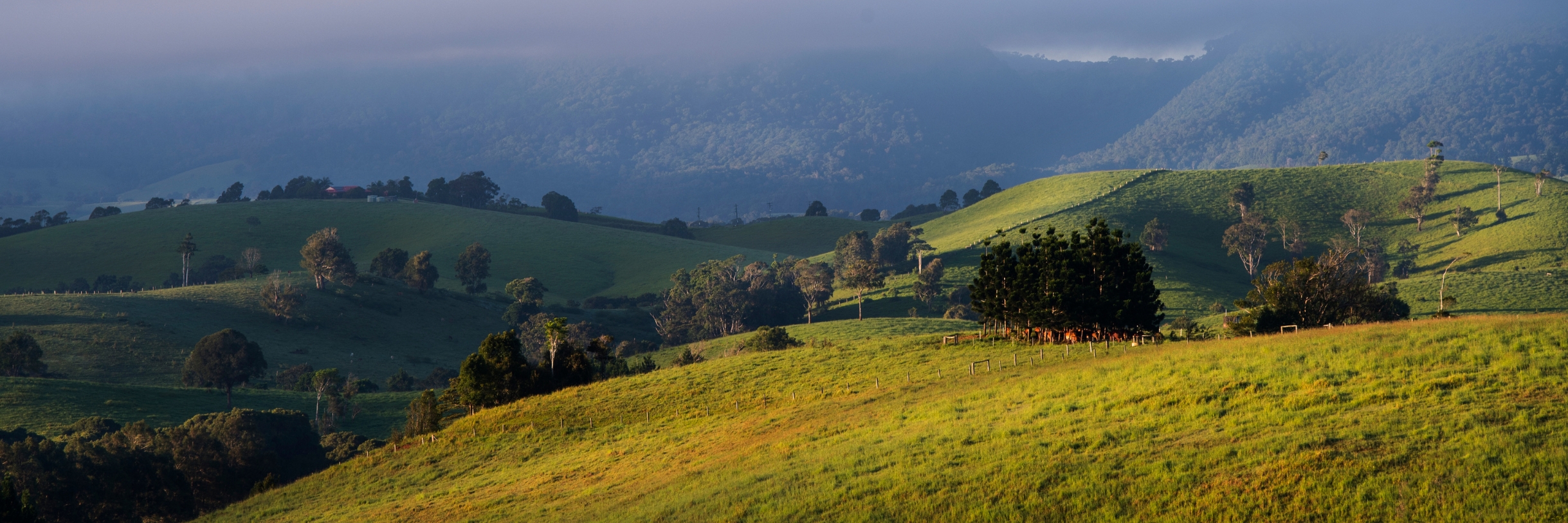
The Atherton Tablelands is one of the most rewarding day trip destinations from Cairns — and a good guided tour unlocks it in ways that self-drive simply cannot. Knowledgeable local guides know where the platypus surface at dusk, which tree the tree kangaroos prefer, and which waterfall pool is perfect for swimming in the afternoon light. A quality Tablelands tour is part nature guide, part local storyteller, and part time machine into a Queensland that most visitors never expect to find.
Tours from Cairns typically cover around 200 kilometres of highland country in a day — a significant distance, but the roads are good and the scenery makes the journey as rewarding as any individual destination. Most full-day tours depart early in the morning, climbing the range via the Gillies Highway or the Kuranda Range Road, and return to Cairns in the early evening. Half-day tours focus on a specific area — the waterfall circuit, the crater lakes, or the Yungaburra platypus trail.
What Tours Typically Include
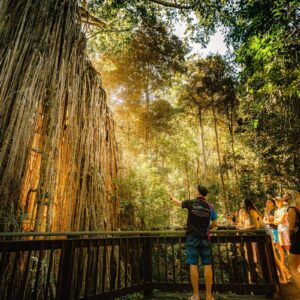
Most Atherton Tablelands tours include visits to the Millaa Millaa Waterfall Circuit, Lake Eacham or Lake Barrine, the Cathedral or Curtain Fig Tree, and a stop at a local farm or coffee plantation. Wildlife spotting — particularly platypus at Yungaburra and tree kangaroos in season — is a highlight of evening and dawn tours. Some operators specialise in birding, Indigenous cultural history, or farm-to-table food experiences. There is a tour style to match nearly every interest.
Choosing the Right Tour
Small-group tours offer the most intimate experience — better wildlife spotting, more flexibility, and genuine conversation with your guide. Larger coach tours cover more ground at higher efficiency, with air-conditioned comfort on a longer route. If you have a hire car, a self-drive Tablelands itinerary is entirely achievable — but take a tour at least once to learn what to look for. You will see the Tablelands differently forever after.



What’s Included in Atherton Tablelands Tours
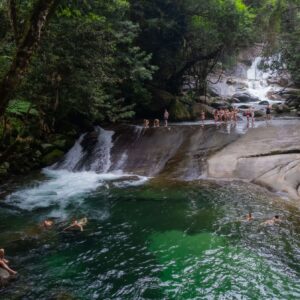
Most full-day Atherton Tablelands tours from Cairns depart in the morning and return in the late afternoon or early evening. The best tours include visits to iconic waterfalls — Millaa Millaa Falls is the most photographed in the region, with its perfect circular pool and lush framing — alongside wildlife encounters (platypus in the wild is a genuine possibility at the right locations), stops at Malanda and Yungaburra villages, and lake visits at the volcanic crater lakes of Barrine and Eacham. Lunch is often included, typically featuring local produce from a region celebrated for its dairy and tropical fruit farms.
Driving the Tablelands Yourself
For visitors with a rental car, self-driving the Atherton Tablelands is one of the great road trip opportunities in Australia. The Waterfall Circuit — a loop through Millaa Millaa, Zillie Falls, Ellinjaa Falls and Malanda Falls — is particularly rewarding and takes approximately four to five hours with stops. Allow a full day for a comprehensive Tablelands self-drive. The Kuranda Scenic Railway provides an alternative way to reach the highlands, with the option of descending via Skyrail Rainforest Cableway — a combination that makes for one of the great day trips in tropical Australia. To see how the Tablelands sit above the coast, explore the Atherton Tablelands on the Cairns Explorer.
Wildlife on the Atherton Tablelands
The Atherton Tablelands is home to some of the most significant wildlife habitat in Australia. The region supports tree kangaroos — rare primates of the rainforest canopy that are genuinely difficult to see elsewhere — alongside Lumholtz’s tree kangaroos in the rainforest remnants around Yungaburra and Malanda. Platypus are regularly seen at Peterson Creek in Yungaburra at dawn and dusk. Birdwatching is exceptional throughout the region, with some species found nowhere else in Australia. The lakes at Barrine and Eacham support waterbirds, freshwater turtles and a diverse fish population in their clear volcanic waters.
How Long a Tablelands Day Takes
Most full-day tours depart early in the morning, climb the range via the Gillies Highway or the Kuranda Range Road, and return to Cairns in the early evening. The Tablelands are only about an hour from the coast, but the day is made of the circuit rather than the drive, so plan on giving it the whole day. Half-day tours focus on a single area — the waterfall circuit, the crater lakes, or the Yungaburra platypus trail — and are the better choice if you also want part of the day in the city.
Helping Look After This Place
Part of the pleasure of a place like this is knowing it will still be here, just as it is, for the people who come after you. A few small choices make a real difference.
- Take everything out that you brought in, including fruit peel and tissues, which do not break down as quickly as people expect in the rainforest.
- Stay on the formed tracks. It protects fragile root systems and stops new informal paths forming, and it is also the single simplest way to stay safe.
- Give wildlife room and resist the urge to feed anything. Queensland Government advice is that feeding cassowaries is illegal, dangerous and has resulted in cassowary deaths.
- Support the small local businesses you pass. A coffee in a village bakery or an entry fee at a family-run attraction is what keeps these communities able to look after the places you have come to see.
- Sunscreen, insect repellent and soap all end up in the water when you swim. Rinsing off before you get in, and swimming without them where you can, is a small kindness to a small creek.
- The Wet Tropics Management Authority acknowledges Rainforest Aboriginal Peoples as the Traditional Custodians of the Wet Tropics. Where a site has a traditional name or story, using it is a quiet way of recognising a connection that long predates tourism.
Where To Go Next
The Tablelands sit above and beyond Kuranda, so the two are often confused. Kuranda is the village at the top of the range and can be reached by scenic railway or Skyrail; the Atherton Tablelands are the highland country past it.
Comparing options for the same day? See Cairns day trips for the full-day alternatives, half-day tours for the shorter ones, and things to do in Cairns today if you are deciding what fits into the time you have.
Practical planning: getting around Cairns covers hire cars for driving the Tablelands yourself, and what to pack explains why a light layer matters at altitude.
A Hot Getaways destination. Where Care is Our Compass.
Travel Kindly
At Hot Getaways, care is our compass — and a little kindness makes every journey better. When you visit Cairns, we gently ask you to:
- Protect the reef — wear reef-safe sunscreen and never touch or stand on the coral.
- Respect the wildlife — admire the birds, turtles and rainforest creatures from a distance, and take your rubbish home with you.
- Support local — choosing local operators, cafés and guides helps this beautiful place thrive.
- Honour Country — we travel on the traditional lands and sea Country of Australia’s First Peoples, with gratitude and respect to the Traditional Custodians past and present.
- Be kind to each other — a smile, a little patience and a helping hand make the day lovelier for everyone.
Small acts of care add up to something wonderful. Thank you for travelling kindly.
Honest Suitability: Is Atherton Tablelands Tours Right For You?
We would rather help you choose well than persuade you to go. Here is our honest assessment.
| Visitor | Our honest view | Why |
|---|---|---|
| Visitors nervous about the range roads | Yes, this is the main reason to take a tour | The Gillies and Kuranda ranges are winding by nature. Letting somebody else drive means you actually see the country. |
| Visitors without a car | Yes | The Tablelands are difficult to explore properly without a vehicle, and a tour solves that. |
| Visitors who want to swim at the falls | Check the itinerary | Not every tour stops long enough to swim. If a swim at Millaa Millaa matters to you, confirm it before booking. |
| Independent travellers | You may prefer to self-drive | The Waterfall Circuit is a 17 kilometre sealed loop, according to Tourism Tropical North Queensland, and the villages reward unhurried stopping. |
| Wildlife hopefuls | Choose a dawn or dusk tour | Platypus and tree-kangaroos are creatures of the edges of the day. A ten to four itinerary is the wrong shape for seeing them. |
| Visitors with limited mobility | Confirm with the operator | Vehicle and transfer accessibility varies by operator and we do not estimate it. On the sites themselves, Queensland Parks and Wildlife Service states that the Curtain Fig boardwalk has no stairs but does not meet the Australian Standard for disability access and may be usable with assistance, and that there are no wheelchair-accessible facilities at Malanda Falls Conservation Park, in Danbulla National Park and State Forest, or at Mount Hypipamee, where the track to the viewing platform is nonetheless sealed. The Tablelands Waterfall Circuit falls are council-managed and their accessibility is unverified. Verified with QPWS on 3 August 2026. Our accessible Cairns trip guide covers this alongside beach and reef accessibility. |
Time-Aware and Season-Aware Planning
- A full day is the standard, and it is the right length.
- Half day tours generally reach only the near edge of the Tablelands.
- Dawn or dusk options are the ones to look for if wildlife matters more than waterfalls.
- Season: Rainfall here is strongly seasonal. Bureau of Meteorology long-term averages for Cairns Aero (station 031011, 83 years of record) are 404.8 mm in January, 437.5 mm in February and 422.1 mm in March, against just 26.5 mm in August, with an annual average of 2,025.5 mm. Source: Bureau of Meteorology climate statistics, Cairns Aero. The Tablelands are genuinely cooler than the coast, which surprises visitors who packed only for the tropics. Bureau of Meteorology long-term averages for Kairi Research Station on the Tablelands give a July mean maximum of 21.1°C and a July mean minimum of 11.2°C, against a July mean maximum of 25.9°C at Cairns Aero. Source: Bureau of Meteorology, Kairi Research Station.
Verified Safety Information
Safety comes before everything else on this page. Every point below is drawn from an official source, and we link to those sources so you can check the current position yourself.
- Queensland Parks and Wildlife Service, which manages these sites, states the position plainly: rivers, creeks and lakes in Queensland’s parks and forests may contain hidden dangers, are not patrolled by lifesavers, and are not the same as a swimming pool — you enter the water at your own risk. Read and follow the on-site signs, and stay out of the water during and after heavy rain, when creeks can rise quickly and run with strong currents. Source: Water safety, Queensland Parks and Wildlife Service.
- This is cassowary country. Queensland Government advice is to never approach an adult cassowary, never approach a chick or get between a chick and its father, and never feed a cassowary — feeding is illegal, dangerous, and has resulted in cassowary deaths. Give them space and observe from a distance. Source: Southern cassowary, Queensland Government.
- When driving in cassowary habitat, Queensland Government advice is to slow down and to never stop your vehicle to look at a cassowary on the road. Source: Southern cassowary, Queensland Government.
- Check Queensland park alerts and warnings for the Tropical North Queensland region before you leave home, together with current weather and road conditions.
- Bring a towel and something warm. Tablelands water and Tablelands evenings are both cooler than the coast.
Queensland Parks and Wildlife Service puts it plainly: parks and forests are wild places with hidden dangers for the unwary visitor. Before you leave home, check Queensland park alerts and warnings for the Tropical North Queensland region, along with current weather and road conditions, and pay close attention to warning signs when you arrive.
Local Knowledge
The points below are local knowledge and editorial judgement rather than operational facts. They are the things we would tell a friend. Conditions change, so treat them as a starting point and always follow official signage and advice.
- Ask what the tour does about swimming before you book. It is the single biggest difference between itineraries that look identical.
- A dawn or dusk tour is worth more than a bigger list of stops. Nobody remembers the sixth lookout; everybody remembers the platypus.
- If you would rather self-drive, the circuit itself is easy. It is only the range roads that put people off, and they are not difficult, just winding.
- Buy something at a farm gate or a village bakery. It costs very little and it is what keeps these communities able to look after the country you came to see.
Common Questions About Atherton Tablelands Tours
Is it better to take a tour or self-drive the Atherton Tablelands?
If winding range roads do not appeal, or you have no car, take a tour. If you want to stop when you feel like it and swim without watching the clock, self-drive. The Waterfall Circuit itself is a 17 kilometre sealed loop, according to Tourism Tropical North Queensland.
Do Atherton Tablelands tours include swimming?
Some do and some do not. It is the most common source of disappointment, so confirm it before booking if a swim at Millaa Millaa Falls is part of why you are going.
Which tour is best for seeing wildlife?
One that operates at dawn or dusk. Platypus and Lumholtz tree-kangaroos are most active at the edges of the day, and no tour can guarantee a sighting at any hour.
What should I bring on an Atherton Tablelands tour?
A towel, swimmers, walking shoes and a warm layer. Bureau of Meteorology long-term averages for Kairi Research Station on the Tablelands give a July mean minimum of 11.2 degrees, which surprises visitors who packed only for the tropics.
Where To Go Next
What a Tablelands tour usually covers, and what it sometimes misses.
- Atherton Tablelands — The region itself, town by town.
- The Waterfall Circuit — What you would drive if you drove it yourself.
- Millaa Millaa Falls — The swimming fall most tours stop at.
- Yungaburra — The village most tours pass through.
- Lake Eacham — The crater lake with the established swimming area.
- Waterfalls Near Cairns — Every waterfall in the region.